




This week, we’re sitting down with Ally Head, Marie Claire’s Senior Health and Sustainability Editor, marathon runner, and champion of women’s health. She shares her take on wellness fact versus fiction, opens up about her experience with PCOS, and explains how she balances marathon training with a busy, thriving career.
Q: You spend your career reporting on health. What are the biggest misconceptions you see repeated in the wellness space?
That lifting weights will make you bulky, that banking more workouts automatically means more fat lost, and that all women should be cycle syncing, aka training and eating differently at different phases of their menstrual cycle. Weights are instrumental for maintaining metabolism and bone density, overtraining can actually hinder progress, and there isn't enough evidence to conclusively prove that cycle syncing actually works.
Any wellness routine that promises the world in a short space of time should ring alarm bells - healthy living is a lifestyle, and one you build for yourself day in, day out. I'm always sceptical of anyone who recommends fasted training without taking into account the individual's activity level, genetics, and current lifestyle. Women respond very differently to fasted workouts than men, for example, and the majority of the research has been done on male participants.
What I preach day in, day out at MC UK and on my own platforms is that there's no such thing as one "perfect" healthy lifestyle, diet, or workout - every body is different, and so what works for you may not for the next. We're also seeing a shift back towards quick fixes at the moment, with people taking TikTok trends and what influencers without qualifications say as gospel. But recovery, sleep, and a sustainable routine are just as important as the workouts themselves.

Q: When were you first diagnosed with PCOS, and what was that experience like for you at the time?
I was really young when I was first diagnosed - 14 years old - and it was quite a shock. I was told I may have difficulty conceiving and then put on the contraceptive pill - end of appointment, no follow-ups or further explanation. I now spend my career teaching women how to advocate for themselves and encouraging others in my position to ask more questions - 1 in 10 women in the UK have PCOS, and more needs to be done to support us and our condition. Putting women on the contraceptive pill to mask their symptoms is a Band-Aid, not a solution.
Q: What have you learned about managing PCOS that you wish you had known earlier?
So much. PCOS doesn't have to define you, and there are simple lifestyle tweaks that can help ease your symptoms and boost your quality of life.
Q: Were there any lifestyle changes (ie. nutrition, movement, sleep, or stress management) that made a noticeable difference for you?
I adopted an inflammation-specific diet back in 2023 to ease symptoms, and the results have been nothing short of transformative. I started by going back to basics, upping my protein and fibre massively and making sure every single meal - even breakfast - was centred around these. I also stopped leaning on sweeter breakfasts (I'm looking at you, porridge and protein shakes) that I thought were "healthy" but weren't actually working for me.
After six months of the inflammation diet, and of monitoring my glucose levels with a CGM to see which foods caused irregular blood sugar spikes and which didn't, I felt like a new person. I had more energy, my persistent acne had cleared up, and I'd lost weight without trying. The decision to lean on CGM data was pivotal for me as a woman with PCOS, as we can't process insulin in the same way as others, and it gave me real-time insight into which foods my body responded well to and which it didn't. Before, I'd been scared of carbs and constantly in a cycle of crash dieting - now, while I'm mindful of my carb intake, I know that I've spent the time learning what my body responds best to. Food became a source of fascination, rather than fear.
I know that rye bread, sourdough and complex carbohydrates are best for my body and don't leave me in a constant craving cycle. I'm also really aware of my sugar intake now, making sure any sweet treats I have are post-meal rather than in the middle of the day.
I also know (despite being a runner and loving my cardio) that low-impact workouts and strength training are generally better for my condition, helping to keep my body strong but not constantly on high alert.
Q: There’s a lot of noise in the wellness world. What principles or habits do you personally come back to again and again?
Food is so important and often overcomplicated, in my opinion. I'm lucky that my Mum is a chef, so we were always taught about how impactful home-cooked meals and wellness from the inside out can be. Cooking and meal prepping form the foundation of mine and my husband's wellness - we genuinely enjoy cooking together and trying new healthy recipes.
You also can't replace consistently. If more people focused on a wholefood diet, banked eight hours of sleep a night, focused on their hydration, and prioritised 30 minutes of exercise a day, the world would be a happier place.
Q: What does “feeling good” actually mean to you - personally and professionally?
Personally, it means having enough energy and stability to move through the day without thinking about my health. It’s sleeping well, feeling physically strong, managing stress well, and having a balanced relationship with food and exercise. It’s less about chasing an ideal state of “optimal wellness” and more about feeling resilient and functional most of the time.
Professionally, covering health has made me more cautious about how that phrase is used. In the wellness industry, “feeling good” is often framed as a kind of constant glow or peak performance, which just isn’t realistic. In reality, people feel good when the basics are working: consistent sleep, regular movement, good nutrition, supportive relationships, and access to healthcare. Those fundamentals are far more predictive of wellbeing than most trends or products.
I also think it’s important to acknowledge that “feeling good” isn’t just an individual responsibility. Social factors- like work conditions, financial stress, and access to safe environments for exercise or healthy food - play a huge role in how people feel day to day.
So for me, the idea of feeling good is less about perfection and more about sustainable habits, realistic expectations, and the capacity to recover when things go off track.
Professionally, covering health has made me more cautious about how that phrase is used. In the wellness industry, “feeling good” is often framed as a kind of constant glow or peak performance, which just isn’t realistic. In reality, people feel good when the basics are working: consistent sleep, regular movement, good nutrition, supportive relationships, and access to healthcare. Those fundamentals are far more predictive of wellbeing than most trends or products.
I also think it’s important to acknowledge that “feeling good” isn’t just an individual responsibility. Social factors- like work conditions, financial stress, and access to safe environments for exercise or healthy food - play a huge role in how people feel day to day.
So for me, the idea of feeling good is less about perfection and more about sustainable habits, realistic expectations, and the capacity to recover when things go off track.
Q: Ok, I'm sure there are a lot of aspiring marathon runners in our community - with such a busy career, how do you realistically fit marathon training into your schedule, and what advice would you give someone wanting to start?
It's a great question. Diarising my workouts is essential for me, as is forward planning as much as possible to ensure I've got time to fit everything in. I also swear by 6 am starts and morning workouts - as I call it, my "day before my day". You can fit so much in in the hours before everyone else wakes up, and I love how peaceful the world seems before day runs away with you.
For beginner runners, embrace being at the start of your journey and enjoy the process. I'd recommend getting a race booked in - a 5km or 10km - to give yourself a set goal and date to work towards. When you're feeling really unmotivated, try the 5-minute rule - where you tell yourself you only *have* to workout for five minutes, and then if you're really not enjoying it, you can stop. Often, the hardest part is actually getting out the door.

Q: Marathon training puts huge demands on the body. How do you approach recovery and making sure you’re supporting your health long term?
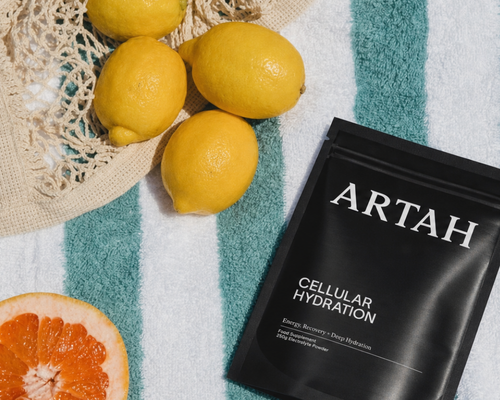
I'm pretty hot on my recovery, as I know from burnout in my mid-twenties that it's as important as working out. I swear by the ARTAH’s Advanced Multi-Nuitrient, Cellular Hydration (it's hands down one of the tastiest electrolytes on the market and packed full of all the good stuff) and Creatine to keep my body and mind healthy. I take Essential Magnesium every night before bed to boost sleep quality and muscle recovery, and I also only ever do one big training block a year - we're increasingly seeing so many influencers online do back-to-back marathons, which is a huge amount to ask of your body, in my opinion. Quality over quantity!
Q: If someone wanted to start running this week, what’s one thing you’d suggest?
Approaching it from a place of joy. With wellness, it's so easy to get trapped in a cycle of focusing on what we "should" be doing, rather than what feels right for us and genuinely makes us excited. If you're in a positive place mentally and see running as the privilege that it is - we get to run, we don't have to! - then it can boost your body and mind in so many ways. I'm forever grateful for the confidence it's given me, and the life it's enabled me to shape.
Q: Looking back, is there anything you wish you’d understood sooner about health or wellbeing?
That there's no one-size-fits-all, and that copying and pasting someone else's version of wellness is a surefire way not to truly get to the bottom of what works best for you. It'll take a bit of trial and error, but trusting your body enough to tell you what it needs is so key. As is embracing what healthy living can add to your life - it should never feel like a chore, rather, a privilege.
Quickfire Round:
- Go-to pre-run meal? For runs under 45 minutes, I love flax crackers and nut butter. For any longer stints, simpler carbs work best for me - so rye bread, sourdough, or a bagel with peanut butter and a banana.
- Favourite pudding? My love for a proper, authentic tiramisu knows no bounds. Or, in summer, fresh gelato and fruit.
- Coffee or wine? The most difficult question! I'd have to say coffee... It's one of life's greatest joys.
- Show you're watching right now? Industry on the BBC. We've just finished season one - it's addictive.
- Best book you've read lately? I'm currently finishing the latest Thursday Murder Club, and then can't wait to get stuck into Lily King's Heart Lover.
- Best shoes for road running? I swear by my ON Cloudmonsters, but also love the New Balance Fuel Cell Rebels or most HOKA designs.
- Least favourite exercise? Burpees!
- One can't live without wellness tool? I fear I have to answer running trainers here... but I also love my acupressure mat. I lie on it every night before bed, and it's so effective for helping me unwind.
- Favourite brunch spot in London? I am a sucker for a good pastry and can't stop raving about Mahali in Battersea. There are also so many great spots in Camberwell - Gladwells, Irene, or Toad Bakery being my go-to's.
Follow Ally:
https://www.tiktok.com/@allyyyhead


