


The Science Behind Enhanced NAD+ Complex
Four pathways. One coenzyme. The cellular foundation of how your body produces energy, repairs itself, and ages.
Why NAD+ matters more as you age
NAD+ Naturally Declines with Age
NAD+ is the coenzyme every cell in your body uses to produce energy, maintain mitochondrial function, and run the repair processes that keep them working. Levels of NAD+ naturally decline with age; research has shown they can drop substantially between young adulthood and middle age across multiple tissues. This decline affects how your cells produce energy, manage oxidative stress, and repair themselves. Supporting NAD+ levels is one of the most actively researched areas in cellular health science.

How the formulation works
Four ways to support your NAD+
Most NAD+ supplements provide a single NAD+ precursor, however, this only addresses one aspect of NAD+ biology. This formulation works in four ways at once: supplying the building blocks your cells convert into NAD+, protecting the NAD+ you already have from the enzymes that consume it, supporting the cellular environment NAD+ depends on, and replenishing the methyl groups used up along the way.
- Boost NAD+ production — nicotinamide riboside and nicotinamide feed the salvage pathway your cells use to make NAD+
- Reduce NAD+ depletion — apigenin, quercetin and luteolin inhibit CD38, the enzyme that consumes NAD+ at accelerating rates with age
- Support the system around NAD+ — maritime pine bark, Panax ginseng and saffron support the antioxidant and mitochondrial environment NAD+ operates in
- Support methylation — TMG replenishes the methyl groups consumed during NAD+ metabolism, supporting the body's broader methylation needs
10 active ingredients, each chosen for a specific role in supporting NAD+
Boost NAD+ production
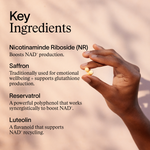
- Nicotinamide riboside (NR): an NAD+ precursor your cells convert directly into NAD+ via the NRK enzyme pathway.
- Nicotinamide: a form of Vitamin D3 and second NAD+ precursor that enters the salvage pathway downstream of NR.
Reduce NAD+ depletion
- Apigenin: a plant flavonoid that inhibits CD38, the enzyme responsible for consuming NAD+ at accelerating rates with age.
- Quercetin: a plant flavonoid with CD38-inhibiting action, studied for its broader role in immune modulation, antioxidant defence, and the body's inflammatory response
- Luteolin: a CD38-inhibiting flavonoid, working alongside apigenin and quercetin to reduce NAD+ depletion.
Support the system around NAD+
- Maritime pine bark: a rich source of proanthocyanidins – plan polyphenol - which support the body's defences against oxidative stress. MPB is traditionally used for vascular health, supporting blood flow and circulation, and as a non-hormonal support throughout perimenopause and menopause.
- Panax ginseng: a traditional adaptogen containing ginsenosides, plant compounds studied for their role in supporting the NAD+ salvage pathway, reducing oxidative stress, and supporting cellular energy production. Panax Ginseng is traditionally used to support sexual function, libido, mental performance, concentration, alertness, mental capacity, and the reduction of mental fatigue.
- Saffron: an extensively studied botanical renowned for its role in mood, cognitive function, stress resilience, and cellular protection.
Methylation support
- TMG (trimethylglycine): a methyl donor that helps replenish the methyl groups consumed during NAD+ metabolism

How NR becomes NAD+
Inside the salvage pathway
Your cells convert NAD+ precursors into usable NAD+ through a defined enzymatic pathway known as the salvage pathway. It's called salvage because NAD+ isn't a one-time resource; it's continuously broken down during cellular processes and then rebuilt from its components. Nicotinamide riboside enters this pathway as a precursor, gets converted by your cells' NRK enzymes and is then transformed into NAD+. After NAD+ is used by enzymes like sirtuins and PARPs, it's broken down to nicotinamide which re-enters the same pathway to make new NAD+.

A formula you can trust
NAD+ is one of the most actively researched compounds in longevity science, with new human clinical work published regularly.
ARTAH's Enhanced NAD+ Complex is always third-party tested so you can trust you're getting everything you need, and nothing you don't.
Full references
1. H, Grant R, Braidy N, Guest J, Farnsworth B, Guillemin GJ. Age-Associated Changes in Oxidative Stress and NAD+ Metabolism In Human Tissue. PLoS ONE. 2012;7(7):e42357.doi: 10.1371/journal.pone.0042357. PMID: 22848760.
2. Bieganowski P, Brenner C. Discoveries of nicotinamide riboside as a nutrient and conserved NRK genes establish a Preiss–Handler independent route to NAD+ in fungi and humans. Cell. 2004;117(4):495–502.doi: 10.1016/S0092-8674(04)00416-7. PMID: 15137942.
3. Ratajczak J, Joffraud M, Trammell SAJ, et al. NRK1 controls nicotinamide mononucleotide and nicotinamide riboside metabolism in mammalian cells. Nature Communications. 2016;7:13103.doi: 10.1038/ncomms13103. PMID: 27725675.
4.Covarrubias AJ, Perrone R, Grozio A, Verdin E. NAD+ metabolism and its roles in cellular processes during ageing. Nature Reviews Molecular Cell Biology. 2021;22(2):119–141.doi: 10.1038/s41580-020-00313-x. PMID: 33353981. PMCID: PMC7963035.



Bestseller
Award winner